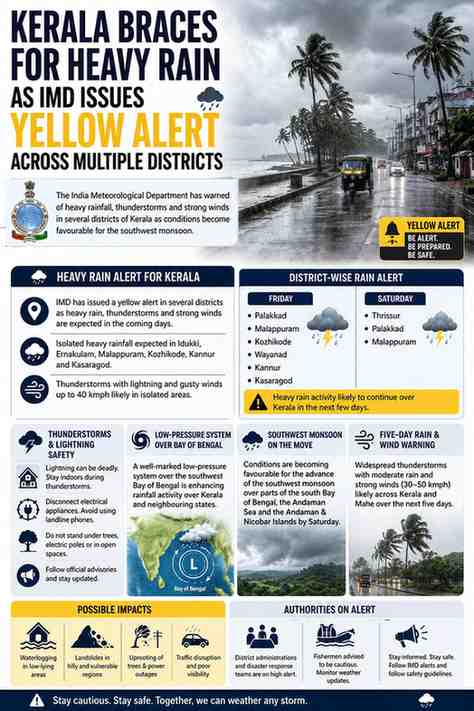
IMD has issued a yellow alert in multiple Kerala districts amid forecasts of heavy rain, thunderstorms and strong winds as monsoon conditions strengthen over the region.
India Meteorological Department has issued a yellow alert in several districts of Kerala as the state prepares for another spell of heavy rain, thunderstorms and gusty winds over the coming days.
According to the latest weather bulletin released on Thursday, isolated heavy rainfall is expected in six districts — Idukki, Ernakulam, Malappuram, Kozhikode, Kannur and Kasaragod — prompting authorities to advise residents to remain cautious and follow safety instructions.
The weather department has also warned of thunderstorms accompanied by lightning and strong winds reaching speeds of up to 40 kmph in isolated areas.
Officials said changing weather conditions over the Bay of Bengal and the Arabian Sea are contributing to increased rainfall activity across southern India, particularly Kerala and adjoining regions.
Heavy Rain Forecast for Several Districts
The IMD stated that heavy rain activity is likely to continue over Kerala during the next few days, with different districts expected to experience varying intensities of rainfall.
For Friday, weather alerts have been issued for Palakkad, Malappuram, Kozhikode, Wayanad, Kannur and Kasaragod districts, where heavy showers are predicted.
On Saturday, Thrissur, Palakkad and Malappuram districts are also expected to witness significant rainfall activity.
Meteorologists explained that the current weather pattern is being influenced by a developing low-pressure system over the Bay of Bengal, which is likely to strengthen rainfall conditions across Kerala.
Officials added that several areas could experience sudden heavy downpours, especially during afternoon and evening hours.
Thunderstorms and Lightning Raise Safety Concerns
Along with heavy rainfall, the IMD has issued warnings regarding lightning activity and strong winds across the state.
Authorities cautioned that lightning poses a serious threat to life and property during thunderstorms and urged people to remain indoors during intense weather activity.
Residents have been advised to disconnect electrical appliances during storms, avoid using telephones connected through wires and refrain from touching electrical equipment during lightning conditions.
Disaster management officials also appealed to the public to avoid standing under trees, near electric poles or in open spaces during thunderstorms.
Strong winds accompanying rain may also result in damage to weak structures, uprooting of trees and disruption of power supply in vulnerable areas.
Low-Pressure System Intensifies Over Bay of Bengal
The IMD said a low-pressure area that formed over the southwest Bay of Bengal and adjoining west-central Bay has intensified into a well-marked low-pressure system.
Meteorologists believe the system is likely to play a major role in enhancing rainfall activity over Kerala and neighbouring states over the next several days.
Weather experts explained that low-pressure systems over the Bay of Bengal often contribute to increased moisture inflow toward the southern peninsula, resulting in widespread rain and thunderstorms.
The department stated that the influence of the system could continue to trigger moderate to heavy rainfall across Kerala until at least May 16.
The evolving weather system is also being closely monitored because it may influence the early movement of monsoon currents toward the Indian mainland.
Conditions Becoming Favourable for Southwest Monsoon
The IMD further noted that atmospheric conditions are gradually becoming favourable for the advance of the southwest monsoon over parts of the south Bay of Bengal, the Andaman Sea and the Andaman and Nicobar Islands.
Meteorologists said the southwest monsoon is expected to advance into these regions by Saturday, marking the beginning of the seasonal monsoon progression toward the Indian subcontinent.
The southwest monsoon is a critical climatic phenomenon for India, particularly for agriculture, water resources and overall economic activity.
Kerala traditionally marks the onset of the southwest monsoon over mainland India, usually during the first week of June.
Weather experts stated that the current rainfall activity over the state is consistent with pre-monsoon atmospheric developments often witnessed during May.
Five-Day Rain and Wind Warning Issued
The IMD has forecast widespread thunderstorm activity with moderate rainfall and strong winds across Kerala and the union territory of Mahe over the next five days.
Wind speeds during thunderstorms are expected to range between 30 and 50 kmph in isolated locations.
Officials warned that intense winds may affect transportation, especially in hilly and coastal regions.
Authorities have advised motorists to exercise caution while travelling during heavy rain because visibility may reduce significantly in some areas.
Residents in low-lying and landslide-prone regions have also been asked to remain alert in case rainfall intensity increases further.
Disaster Management Authorities on Alert
State disaster management authorities have stepped up monitoring efforts as weather conditions continue to deteriorate in parts of Kerala.
Officials said district administrations have been instructed to maintain preparedness for any emergency situations arising from heavy rain, strong winds or lightning incidents.
Emergency response teams, local bodies and disaster management personnel are closely tracking weather developments and coordinating precautionary measures.
Authorities have also urged fishermen to exercise caution before venturing into the sea, especially if weather conditions worsen over coastal areas.
Travellers and tourists visiting hilly districts have been advised to remain updated about weather advisories and avoid unnecessary movement during periods of intense rainfall.
Risk of Flooding and Landslides in Vulnerable Areas
Although rainfall intensity has not yet reached extreme levels in most districts, experts warn that continuous rain over several days could increase the risk of localised flooding and landslides in vulnerable areas.
Districts such as Idukki and Wayanad are particularly sensitive to heavy rain because of their hilly terrain and history of monsoon-related disasters.
Authorities are expected to closely monitor river levels, water reservoirs and landslide-prone regions during the coming days.
Local administrations have also been instructed to identify emergency shelters and maintain readiness in case evacuations become necessary.
Officials said public cooperation would be crucial in ensuring safety during adverse weather conditions.
Public Advised to Follow Official Alerts
The IMD and disaster management authorities have repeatedly urged the public to rely only on official weather updates and advisories.
Residents have been advised to remain indoors during severe thunderstorms and avoid risky activities in flooded or unstable areas.
Authorities also stressed the importance of taking lightning warnings seriously, noting that lightning strikes account for a significant number of weather-related fatalities in India every year.
People living in coastal, hilly and flood-prone regions have been asked to remain particularly cautious during the next few days.
Kerala Enters Critical Pre-Monsoon Weather Phase
The latest spell of rain signals the beginning of a crucial weather transition period for Kerala as the state moves closer to the arrival of the southwest monsoon.
Every year, pre-monsoon showers play an important role in reducing summer heat and replenishing water sources before the onset of the main rainy season.
However, increasing weather variability and intense rainfall events in recent years have also heightened concerns about floods, landslides and climate-related disasters.
Meteorologists said the next few days will be important in determining how weather systems evolve over southern India and the Bay of Bengal.
As Kerala prepares for intensified rain activity, authorities continue to emphasise vigilance, preparedness and adherence to official safety advisories to minimise risks and protect lives and property.
Key Insights
- The India Meteorological Department (IMD) issuing a yellow alert across multiple districts in Kerala highlights the increasing frequency and intensity of pre-monsoon weather systems, which are becoming a critical component of seasonal risk management in southern India.
- The development of a low-pressure system over the Bay of Bengal underscores the strong ocean–atmosphere coupling that drives rainfall variability across the Indian subcontinent, particularly influencing moisture inflow into the southwestern coastal belt.
- The forecast of thunderstorms, lightning, and gusty winds reinforces the persistent public safety challenge posed by lightning-related fatalities in India, where lightning remains one of the leading causes of weather-linked deaths during the pre-monsoon and monsoon periods.
- Districts such as Idukki and Wayanad remain especially vulnerable due to their topography, with steep slopes and saturated soil conditions increasing the risk of landslides during prolonged rainfall events.
- The advisory for fishermen, travellers, and residents reflects a multi-sectoral risk communication approach, where weather warnings now extend beyond agriculture to include transport, tourism, and coastal livelihood safety systems.
- The progression of the southwest monsoon into the Andaman region signals the early stages of seasonal shift, which is closely monitored because it determines the timing and distribution of rainfall crucial for agriculture-dependent economies.
- Increasing variability in rainfall intensity and shorter, high-impact downpours point toward broader climate-related concerns, where extreme weather events are becoming more concentrated and harder to predict at local levels.
- Disaster management preparedness measures indicate a shift toward anticipatory governance, where district-level coordination, early warning systems, and rapid response mechanisms are being strengthened to reduce the impact of climate hazards.
Inputs & Images: Hindusthan Samachar
Edited By: Akshaya Polepalli
Also Read: Himanta Biswa Sarma Offers Prayers at Kamakhya Temple, Seeks Peace and Prosperity for Assam
Follow us on google news: Click Here